Introduction
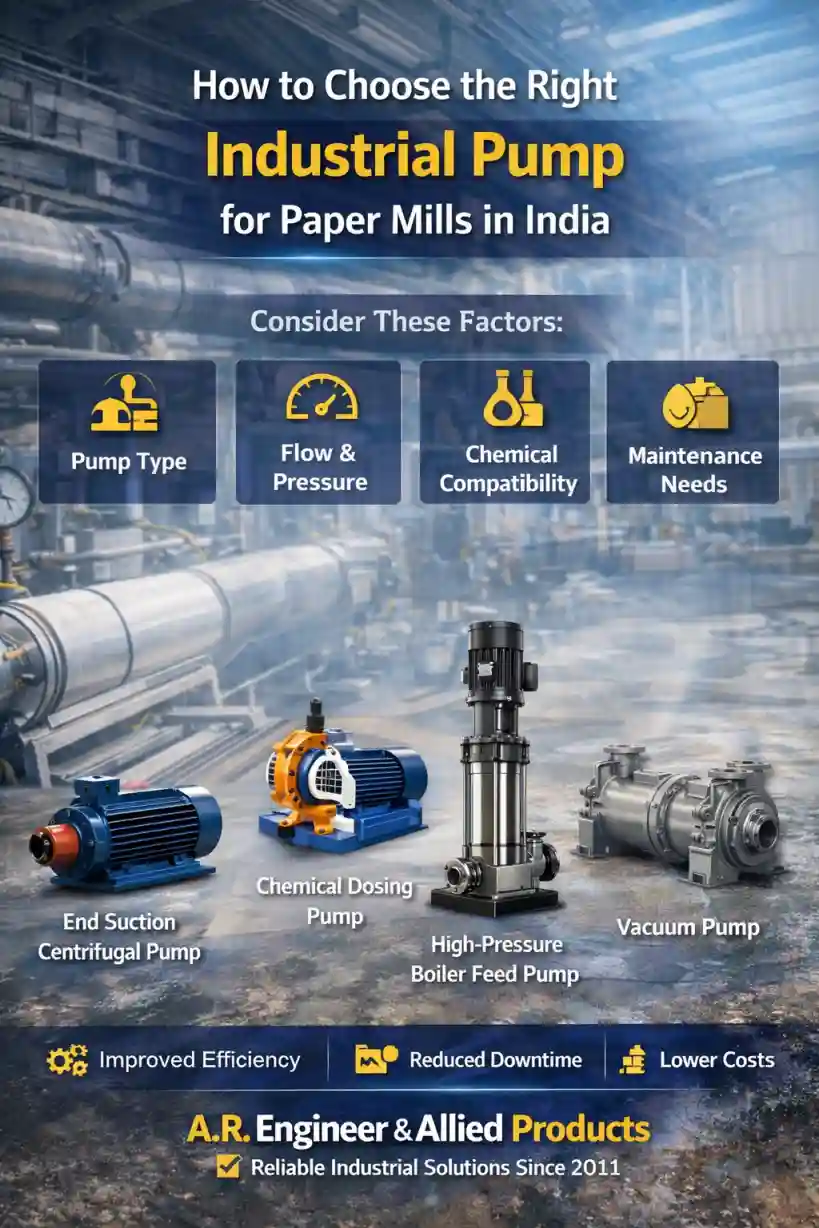
Pumps are one of the most critical components in any industrial setup. Whether it’s the paper industry, chemical processing, water treatment, or manufacturing — pumps ensure smooth fluid movement, pressure control, and process efficiency.
Choosing the right type of pump is not just about moving liquid — it directly impacts energy consumption, maintenance costs, and overall plant performance.
In this guide, we will explore the different types of pumps available in the market, their working principles, and their industrial applications to help you make the right choice.
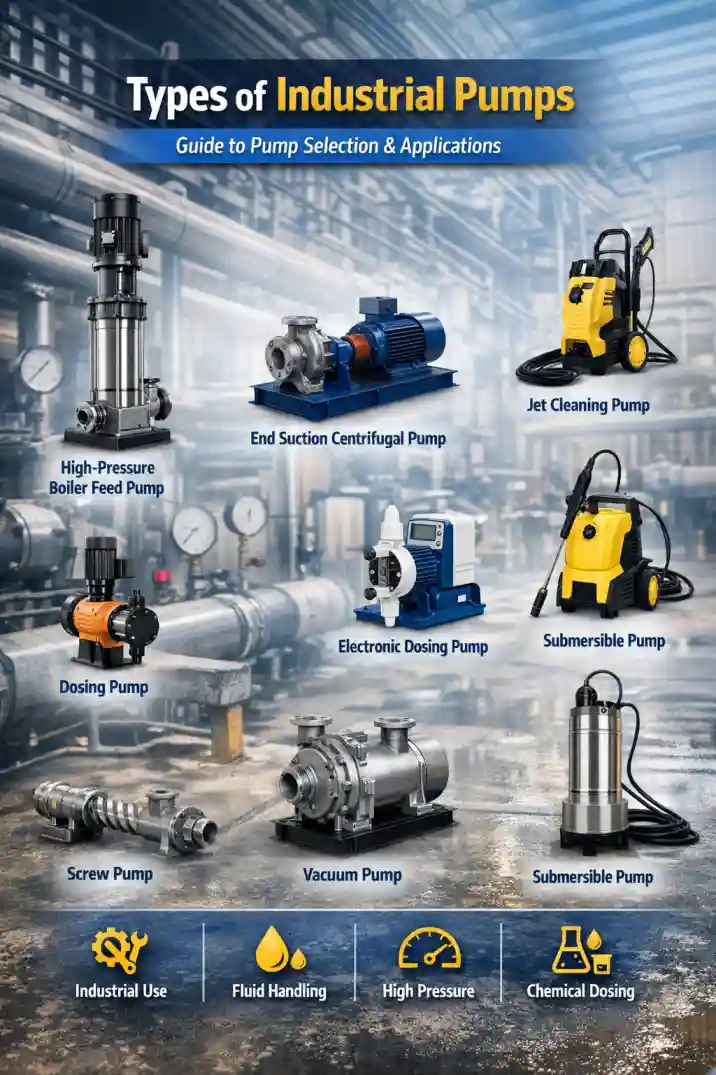
Types of Industrial Pumps
1. High Pressure Vertical Pump (Boiler Feed Pump)
High-pressure vertical pumps are specifically designed for boiler feed applications where water needs to be supplied at very high pressure.
Utility & Applications:
- Boiler feed systems
- Power plants
- Steam generation units
Key Advantages:
- Handles high pressure efficiently
- Compact vertical design saves space
- High reliability in continuous operations
2. End Suction Centrifugal Pump
End suction centrifugal pumps are among the most commonly used pumps in industries due to their simple design and efficiency.
How It Works:
Fluid enters from one end (suction) and is discharged through the outlet using centrifugal force.
Applications:
- Water transfer
- Cooling systems
- Irrigation
- General industrial use
Benefits:
- Easy maintenance
- Cost-effective
- Widely available
3. Jet Cleaning Pump
Jet cleaning pumps are high-pressure pumps used for cleaning surfaces using powerful water jets.
Applications:
- Industrial cleaning
- Equipment maintenance
- Pipeline cleaning
- Surface preparation
Advantages:
- High-pressure output
- Effective cleaning performance
- Reduces manual effort
4. Dosing Pump (Plunger / Diaphragm)
Dosing pumps are used for precise injection of chemicals into a system.
Types:
- Plunger dosing pump
- Diaphragm dosing pump
Applications:
- Water treatment plants
- Chemical industries
- Paper mills
Benefits:
- Accurate chemical dosing
- Controlled flow rate
- Essential for process consistency
5. Electronic Dosing Pump
Electronic dosing pumps are advanced versions of dosing systems with automation and control features.
Applications:
- Automated chemical dosing
- Smart industrial systems
- Process plants
Advantages:
- High precision
- Programmable controls
- Reduced human error
6. Screw Pump (High Viscosity Pump)
Screw pumps are designed to handle thick, viscous fluids.
Applications:
- Sludge handling
- Oil & chemical transfer
- Pulp industries
Benefits:
- Smooth flow
- Handles high viscosity fluids
- Low pulsation
7. Chemical Transfer Pump
These pumps are specially designed to handle corrosive and aggressive chemicals.
Applications:
- Chemical plants
- Acid transfer
- Industrial processing
Key Features:
- Corrosion-resistant materials
- Safe handling
- Durable construction
8. Condensate Pump
Condensate pumps are used to transfer condensed steam back into the system.
Applications:
- Boiler systems
- Steam plants
Benefits:
- Energy recovery
- Improves system efficiency
9. Vacuum Pump (Liquid Ring Vacuum Pump)
Vacuum pumps remove air or gas from a system to create a vacuum.
Applications:
- Paper industry
- Chemical processing
- Vacuum systems
Advantages:
- Efficient dewatering
- Stable performance
- Low maintenance
10. Multistage Centrifugal Pump
These pumps use multiple impellers to generate higher pressure.
Applications:
- High-pressure water supply
- Boiler feed systems
- Industrial processes
Benefits:
- High efficiency
- Suitable for high-pressure applications
11. Submersible Pump
Submersible pumps operate underwater and are commonly used for drainage and sewage systems.
Applications:
- Sewage handling
- Borewell systems
- Water removal
Advantages:
- No priming required
- Efficient operation
- Space-saving
12. Gear Pump
Gear pumps are positive displacement pumps used for precise fluid transfer.
Applications:
- Oil transfer
- Lubrication systems
- Chemical dosing
Benefits:
- Consistent flow
- Handles thick liquids
How to Choose the Right Pump
Selecting the right pump depends on several factors:
- Type of fluid (water, chemical, sludge)
- Required pressure and flow rate
- Temperature conditions
- Viscosity of liquid
- Industrial application
👉 Choosing the wrong pump can lead to higher costs, frequent breakdowns, and inefficient operations.
Why Choose A.R. Engineer & Allied Products
At A.R. Engineer & Allied Products, we provide a wide range of industrial pumps and solutions tailored to your specific requirements.
- ✔ Trusted industrial suppliers
- ✔ Wide range of pump solutions
- ✔ Technical expertise
- ✔ Reliable after-sales support
We serve industries like paper, chemical, water treatment, and manufacturing with proven solutions.
Conclusion
Industrial pumps are the backbone of any processing system. From high-pressure boiler feed pumps to precision dosing systems, each type of pump serves a specific purpose.
Understanding the different types of pumps and their applications helps in making informed decisions that improve efficiency, reduce costs, and enhance productivity.
If you are planning to upgrade your system or select the right pump — expert guidance can make all the difference.
FAQs
1. Which pump is best for high-pressure applications?
High-pressure vertical pumps and multistage centrifugal pumps are ideal for such applications.
2. What is the difference between centrifugal and dosing pumps?
Centrifugal pumps move large volumes of fluid, while dosing pumps are used for precise chemical injection.
3. Which pump is suitable for chemical industries?
Chemical transfer pumps and diaphragm dosing pumps are commonly used due to their resistance to corrosion.
4. What pump is used for thick liquids?
Screw pumps and gear pumps are best suited for high-viscosity fluids.